I built an AI model and it taught me why humans still win
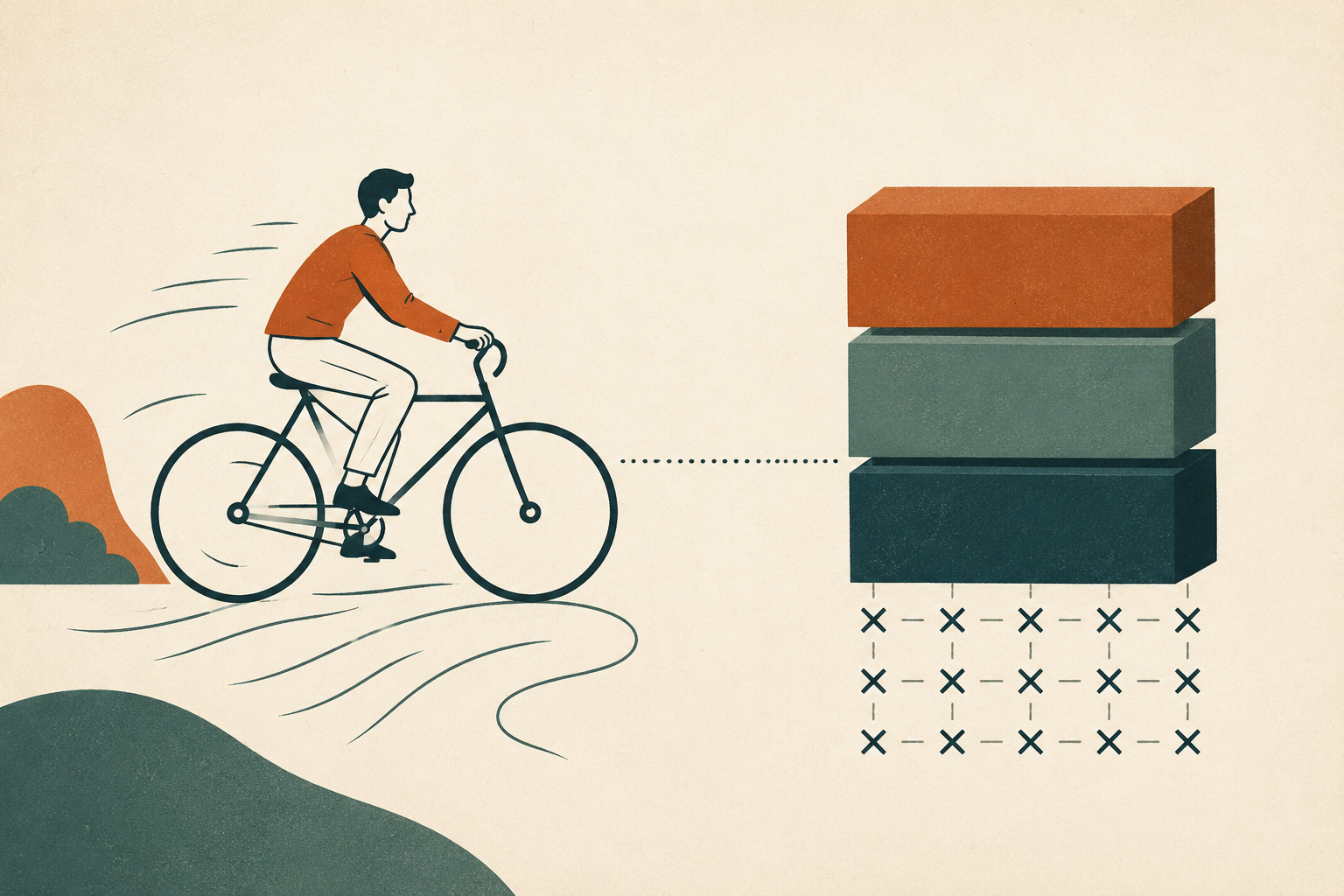
I learned to ride a bike after grade 10. Then I stopped for 6 years. When I picked it back up, I was fluent in 2-3 months. Around the same time, I was building an LSTM model on Nepal’s stock market, 3 stacked layers, 50 features, trained on historical data.
During testing, I hit a wall. 33 of the 50 features I trained on weren’t available at the inference time. So I padded them with zeros. The model didn’t flag uncertainty. It didn’t ask for more context. It just kept outputting answers as if nothing was missing. That’s when I stopped the project.
A junior intern in their first week would have said: “I don’t have enough data to answer this, can I ask?”
That gap kept hammering me. How is a human with 6 years of no practice better at relearning than a model trained on terabytes?
Here’s what I figured out.
1. You arrive pre-wired
A 5 month old infant already understands that objects don’t disappear when hidden, can’t pass through solid barriers, and don’t move on their own. None of this is learned from experience, it’s built in before experience begins.
Elizabeth Spelke’s foundational research on Core Knowledge (1992, Psychological Review: 2007, Developmental Science) established that humans are born with domain-specific systems for representing objects, space, number, and causality. These structured priors exist before any data arrives.
An LLM starts with zero priors. It has to statistically infer all of this from text alone, which is why it needs trillions of tokens to approximate what a child figures out by 5 through lived experience.
Lake, Ullman, Tenenbaum & Gershman (2017, Behavioral and Brain Sciences) put it precisely: human-like machines must start from “developmental start-up software”, intuitive physics and psychology rather than pure pattern recognition. We don’t have that in transformers yet.
2. You learn through your body, not descriptions
When I relearned biking, my inner ear gave balance feedback instantly. My hands felt the road. Pain taught consequences in real time. That’s a direct signal from the world.
Worlpert, Ghahramani & Jordan (1995, Science) showed that the central nervous system builds internal models, simulations of the body’s own dynamics for planning, control, simulating, acting, and receiving feedback directly.
LLMs learn from text descriptions of experience. Imagine learning to ride a bike only by reading about it. That’s why every LLM does, for everything.
3. Transfer is nearly free for humans
I didn’t relearn balance for the motorcycle. I reused an abstraction I already had balance, spatial awareness, motor control built during the bike years. Humans stack concepts on top of concepts. New skills cost almost nothing when they share foundations with old ones.
Gick & Holyoak (1983, Cognitive Psychology) demonstrated this empirically: people who learned an abstract schema from one problem applied it spontaneously to a superficially different problem in a different domain. The structure transferred, not the surface.
LLMs interpolate between patterns in training data. That’s not the same thing. Sample-efficient transfer across domains remains an open research challenge in machine learning (Hassani et al., 2024, arXiv:2441.10268).
4. Sleep consolidates – training runs don’t
After learning, your brain during sleep replays what you experienced, prunes weak connections, strengthens important ones, and compresses redundant information. You literally wake up better at something than when you went to sleep.
Wilson & McNaughton (1994, Science) showed that hippocampal neurons that fired together during a waking task re-fired together during subsequent sleep, the original demonstration of memory replay. Tononi & Cirelli’s Synaptic Homeostasis (2014, Neuron) established the mechanism: sleep renormalizes synaptic strength, consolidating what matters and discarding what doesn’t.
LLMs have no equivalent. One training run. Done. Whatever it learns is frozen.
5. You actively seek what you need
A child drops things repeatedly not for fun, but to test gravity. Goal-directed exploration. Stahl & Feigenson (2015, Science) showed that 11 month old infants who saw objects violate physical expectations ran targeted experiments dropping objects that appeared to defy gravity, banging apparently solid objects on the floor. They were forming and testing hypotheses.
Gopnik (2020, Philosophical Transactions of the Royal Society B) argues that childhood is an evolved “high-tempearture” exploration phase, wide-ranging hypothesis search before narrowing to exploitation.
LLMs are passive. They learn from whatever was in the dataset, no curiosity, no targeted searching, no choosing what to learn next.
So what does this mean?
It means current AI, including the most powerful LLMs, is fundamentally missing something. Not because of scale. Not because of data. Because of architecture.
Judea Pearl said it plainly in The Book of Why (2018): “You are smarter than your data. Data do not understand causes and effects; humans do.” His ladder of causation – association, intervention, counterfactuals describes exactly what LLMs cannot climb. They can see patterns. They cannot ask why.
Yann LeCun understood this and left Meta after 12 years to build something different. His new company, AMI Labs, raised $1.03 billion in seed funding (March 2026) to build world models, AI systems that understand the physical world, maintain persistent memory, reason, and plan. Built on his Joint Embedding Predictive Architecture ( JEPA), which predicts in abstract representation space rather than token space. The V-JEPA 2 paper (arXiv:2506.09985, June 2025) already a system that can anticipate human actions and plan robot movements from video, a model that builds a predictive model of the world, not a language model.
LeCun’s argument: next-token prediction is a dead end for real intelligence.
That’s the frontier I’m researching now. And I’m documenting the whole journey publicly.
References
- Spelke, E. S. et al. (1992). Origins of Knowledge. Psychological Review, 99(4). https://doi.apa.org/doi/10.1037/0033-295X.99.4.605
- Spelke, E. S. & Kinzler, K. D. (2007). Core Knowledge. Developmental Science, 10(1). https://www.harvardlds.org/wp-content/uploads/2017/01/SpelkeKinzler07-1.pdf
- Lake, B. M. et al. (2017). Building Machines That Learn and Think Like People. Behavioral and Brain Sciences, 40. https://arxiv.org/abs/1604.00289
- Wolpert, D. M. et al. (1995). An Internal Model for Sensorimotor Integration. Science, 269. https://www.science.org/doi/10.1126/science.7569931
- Gick, M. L. & Holyoak, K. J. (1983). Schema induction and analogical transfer. Cognitive Psychology, 15(1). https://reasoninglab.psych.ucla.edu/wp-content/uploads/sites/273/2021/04/Gick_Holyoak1983_SchemaInduction.pdf
- Wilson, M. A. & McNaughton, B. L. (1994). Reactivation of hippocampal ensemble memories during sleep. Science, 265. https://www.science.org/doi/10.1126/science.8036517
- Tononi, G. & Cirelli, C. (2014). Sleep and the Price of Plasticity. Neuron, 81(1). https://www.cell.com/neuron/fulltext/S0896-6273(13)01186-0
- Stahl, A. E. & Feigenson, L. (2015). Observing the unexpected enhances infants’ learning and exploration. Science, 348(6230). https://www.science.org/doi/10.1126/science.aaa3799
- Gopnik, A. (2020). Childhood as a solution to explore–exploit tensions. Phil. Trans. Royal Society B, 375. DOI: 10.1098/rstb.2019.0502
- Pearl, J. & Mackenzie, D. (2018). The Book of Why. Basic Books. https://bayes.cs.ucla.edu/WHY/
- Assran, M. et al. (2025). V-JEPA 2. arXiv:2506.09985. https://arxiv.org/abs/2506.09985
- LeCun departure — CNBC (Nov 2025): https://www.cnbc.com/2025/11/19/meta-chief-ai-scientist-yann-lecun-is-leaving-the-company-.html
- AMI Labs funding — HPCwire (Mar 2026): https://www.hpcwire.com/aiwire/2026/03/11/yann-lecuns-ami-secures-1b-seed-to-develop-ai-world-models/.